

The request coming across my desk has changed, and it happened fast enough that I noticed.
Two years ago the ask was almost always some version of “we need someone to fire the team up.” Now it sounds more like “we need someone who leaves them with something they can actually use.” That looks like a small shift in wording. It is not. It changes who you should book.
The lift has a short shelf life
Every planner has lived this. The keynote lands, the room is on its feet, people are still talking about it at the reception. Then Thursday comes and nothing about the way that team works is any different.
Nobody blames the speaker for that, exactly. But planners have started to notice that a great hour and a changed team are two different purchases, and they have gotten a lot more specific about which one they are paying for.
What “engagement” means now
It used to mean a survey score and a pizza party. The rooms I am booking into this fall are dealing with something harder than that.
Teams are running on anxiety-driven hustle and calling it engagement. Managers are avoiding the difficult conversation until it turns into a retention problem. Public sector and nonprofit staff are being asked to do more with less, year after year, and quietly losing the thread on why the work mattered to them in the first place. And every room is more divided than it used to be, without anybody having taught people how to disagree well.
None of that is fixed by an hour of enthusiasm. It gets fixed, if it gets fixed, by giving people a method.
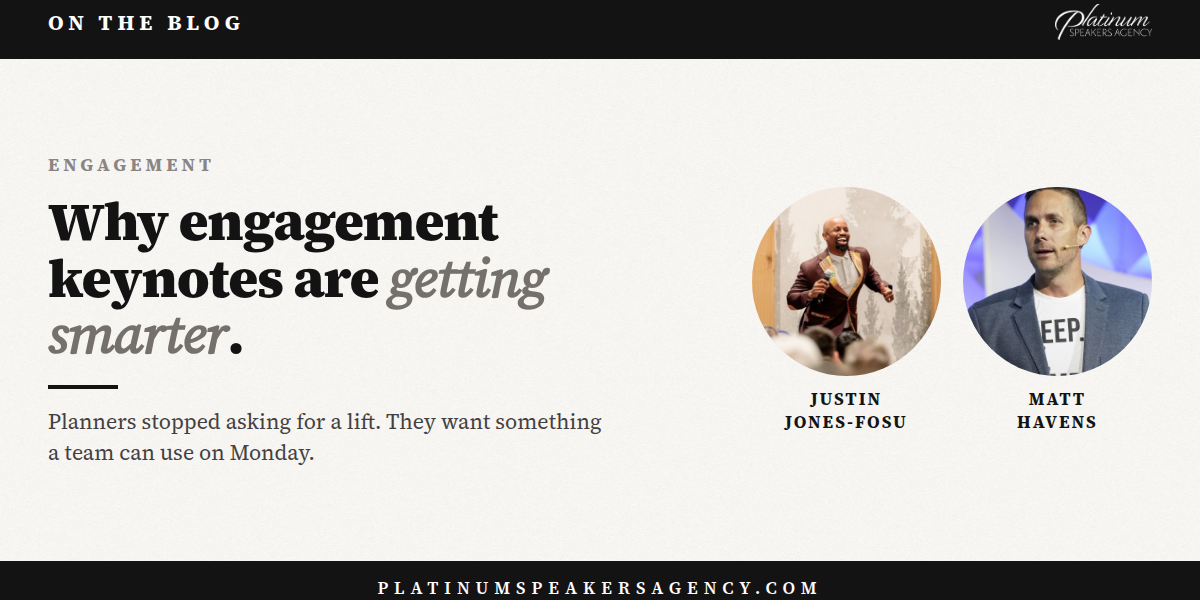
Justin Jones-Fosu: meaning is created, not found
Justin Jones-Fosu built his entire keynote around a distinction that sounds academic until you watch it land: meaning is not something you find at work, it is something you create there.
Waiting to be handed purpose is passive, and passive is where disengagement starts. His Create Meaning Model gives people three things to actually do. Choose it, commit to it, cultivate it, inside the job they already have. It is grounded in the National Study on Meaningful Work in America, so when he says something about why people check out, there is research underneath it rather than a story he liked.
He is in front of HR and public sector audiences constantly, including the California Welfare Directors Association, NCSEA, Allegheny County, Monterra Credit Union, and the Ohio Assisted Living Association.
A VP of Human Resources at FMS put it plainly after his keynote: “We’re so grateful to Justin for speaking at our event. His message was inspiring, relatable, and left our team energized and motivated.”
The other thing planners have been adding lately is his difficult conversations breakout, on how to navigate real disagreement in a divided workplace. It is usually booked as the afternoon session, and it consistently outperforms the slot.
Matt Havens: the problem is not volume, it is priority
Matt Havens opens with a line that reliably makes a room go quiet. Work is not overwhelming because there is too much to do. It is overwhelming because everything feels equally important.
He spent fourteen years leading inside a Fortune 50 company watching capable teams drown in their own priorities, and his Uncomplicate Work keynote goes after the decision underneath all of it. Not how to do more. How to decide what deserves the attention, and how to get a team pointed at the same answer.
That message lands especially hard in agencies and associations where “do more with less” is a budget reality rather than a motivational phrase. His government track record is deep: the Georgia Department of Community Supervision, Texas Health and Human Services, the USDA Natural Resources Conservation Service, Washington County Minnesota, the Minnesota Government Finance Officers Association, and the California Association of Public Administrators, Public Guardians and Conservators.
A Professional Development Manager at the Georgia Department of Community Supervision wrote afterward: “Your insights on building community, finding purpose, and embracing failure were invaluable. Your ability to address these complex and important topics with such clarity and authenticity truly elevated the event.”
He also has The Human Way, which replaces “us versus them” thinking with the shared human patterns behind how people communicate and decide. That one is the stronger fit when the real problem in the building is friction between teams rather than workload.
Why government and nonprofit rooms are their own thing
If you are planning for a public sector or mission-driven audience, you already know these rooms are not corporate rooms with different name badges.
The budget scrutiny is real and constant. The staff did not take the job for the money, which means their connection to the mission is the actual retention strategy, and it is the thing wearing thin. A keynote that only motivates can read as tone deaf in that room, because the audience knows perfectly well that enthusiasm is not what is missing.
What works is a speaker who respects that, names the hard thing out loud, and then hands over something usable. Both of these keynotes do that, from different directions. One reconnects people to why the work matters. The other clears the noise so they can do it.
Three questions worth asking before you book anyone
Whoever you are considering, and whether or not they are on my roster, these three will tell you most of what you need to know.
What will someone be able to do on Monday that they could not do on Friday? A speaker with a real framework answers that in a sentence or two and it sounds specific. A speaker without one talks about energy and takeaways, and the answer never quite arrives.
Have they been in a room like mine? Not a logo wall. The same industry, the same seniority level, and roughly the same size room. Plenty of excellent speakers are only excellent at one of those.
Will they name the hard thing? Ask what they would say from the stage about the thing everybody in your organization is quietly worried about. The answer tells you whether you are hiring a performer or a partner.
The shift is not a trend
I do not think this is a phase planners are going through. Budgets are tighter, agendas are shorter, and every session has to justify the hour it takes up. A keynote that only produces a feeling is a harder line item to defend than it used to be.
The good news is that the speakers who were already doing the harder thing, the ones handing audiences a method instead of a mood, are having their moment. If you are building a fall or 2027 agenda for an HR, government, or people-focused audience, that is the standard worth holding everyone to.