

What healthcare clients actually ask for
When a healthcare organization calls us about a keynote, it is almost never because they want someone motivational. It is because their people are tired in a way that time off has not fixed, and because the usual wellness session did not move anything.
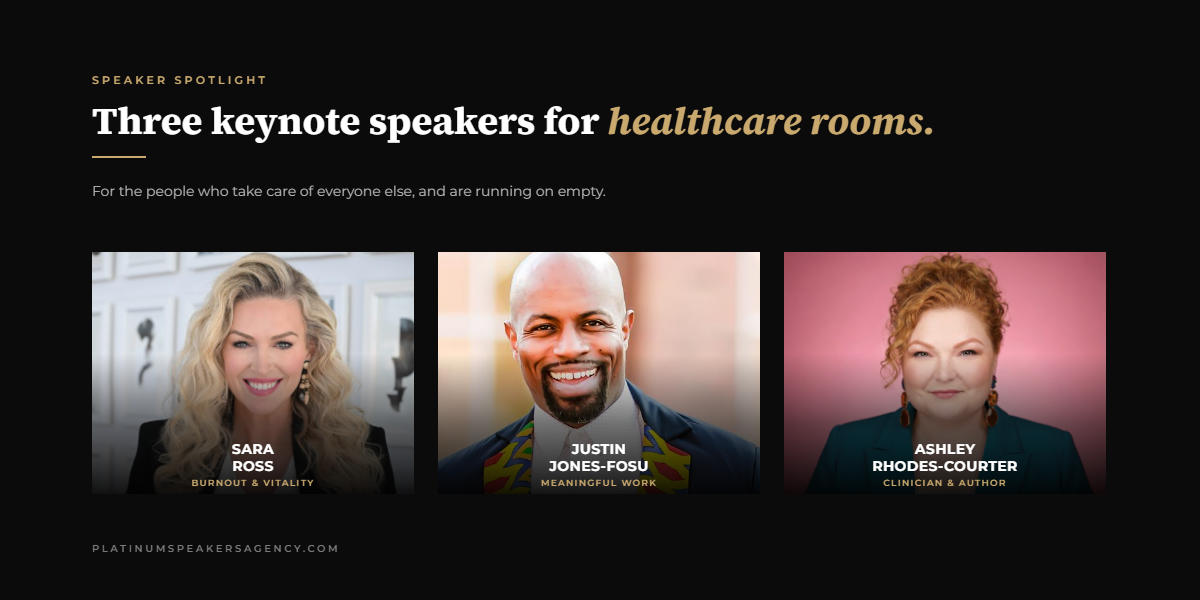
Three of our speakers work that territory. One explains what is happening in the brain. One works on whether the job still means anything. One is a practicing clinician who treats this for a living.
Sara Ross: the science under the exhaustion
Sara is the one I send into rooms full of clinicians and executives who have heard the word burnout so many times it has stopped meaning anything. She does not open with sympathy. She opens with what is actually happening inside a brain that has been running on alert for two years, which is a very different conversation and one that a medical audience will actually sit still for.
Her Leadership Vitality keynote is built on that, and the American Medical Association told us what the preparation looks like from their side:
“The time Sara took to interview our members and customize her keynote only added to the wonderful experience we had with Sara and the keynote on Leadership Vitality she delivered. The feedback has been amazing, and the on-demand recording has record views.”American Medical Association
That customization is not a nice extra in a healthcare room. A nursing audience and a physician leadership audience are carrying different weights, and a speaker who has not asked which one is in front of her will miss both.
She works heavily in financial services too, which is useful context rather than proof for your room. The reason I lead with the AMA note is that healthcare planners want to know a speaker has already held a clinical audience, not that she is popular generally.
Justin Jones-Fosu: when the work stops meaning anything
There is a specific kind of healthcare exhaustion that is not about hours. It is what happens when someone who came into this work for a reason slowly loses the thread back to that reason. Staffing pressure, documentation, moral injury, and years of being asked to do more with less will do that to a person who still loves the job.
That is Justin’s territory. His premise is that meaning is not something you find at work, it is something you create there, and waiting to be handed purpose is where disengagement starts. His frameworks give a room three things to actually do about it inside the job they already have, which matters when nobody can promise the staffing will improve.
Senior living is where he has the most direct healthcare track record. The Ohio Assisted Living Association had him keynote their Fall Conference and Trade Show:
“Your presentation was a highlight of the event. The feedback from our attendees was overwhelmingly positive. Many expressed how much they valued your insights and how impactful your keynote was in setting the tone for the entire conference.”Ohio Assisted Living Association
He is strongest as an opener, when you want the tone of the whole conference set before the breakouts start. He also runs a session on navigating difficult conversations that planners keep adding to the afternoon, which lands in organizations where the tension between departments is the real problem.
Ashley Rhodes-Courter: the clinician in the room
Ashley is the newest fit for this audience and, in some ways, the most obvious one. She is a Licensed Clinical Social Worker and a board-certified trauma professional who runs a mental health agency serving people in high stress, high stakes environments. The burnout and secondary trauma your audience is living with is what she treats for a living. That is a different credential than most speakers bring to this conversation.
She is also a New York Times bestselling author whose story carries a room. She spent nearly a decade in foster care as a child and built stability inside an environment that offered none, one small decision at a time.
Her keynote, Three Little Words, uses a framework she calls the 3 Rs. Regulate, so you are clear headed before you respond. Reframe, so your attention moves to what you can control. Respond, by taking the one small step available now. Every person leaves with three words of their own to act on.
Good Days, after she spoke at their event:
“Your authenticity as a person and inspiring story were truly amazing to witness. You fully resonated with our audience, kept them engaged and helped make our event a tremendous success.”Good Days
Her provider and behavioral health rooms include High Plains Mental Health Center, Service Access and Management, Redwood Community Services, and the Ohio Association of County Boards of Developmental Disabilities. For nursing and provider audiences, the pairing of a story that earns the room with a clinician who can explain what happens to people under sustained stress is unusual. She is the one I would put in front of a group that has been through something hard together.
How to choose between them
The honest shortcut is to name the problem out loud first.
- If your people are running on empty and your leaders need language for it, that is Sara.
- If your people are present but checked out, and the connection to why the work matters has frayed, that is Justin.
- If your team has been through something hard and needs steadiness more than strategy, that is Ashley.
All three customize, and all three are used to rooms where the audience has seen real things. If the right answer is not obvious from the outside, that is usually a fifteen minute conversation rather than a research project.
We have written before about how burnout keynotes have changed, about engagement keynotes getting smarter, and about why healthcare and financial conferences keep landing on the same leadership vitality keynote. The pattern across all of it is the same. The rooms that used to want a lift now want a method, and healthcare got there first.
The rest of the roster is here, and the leadership and resilience pages have more on where each of these three fits.