

There is a number that almost never shows up on a speaker’s one sheet, and it is the one that tells you the most.
How many groups brought him back.
A keynote can land beautifully and still be forgotten a quarter later. The room laughs, the scores come in high, the planner gets a nice note from her boss, and then everyone goes back to the same meetings, the same pressure, and the same habits. Rebooking is the one signal nobody can manufacture. No organization pays a second time out of politeness.
Paul Long, a workplace culture keynote speaker who has spent years in front of exactly these audiences, gets rebooked.
McKesson is bringing him in for a fifth engagement. The Kansas Hospital Association has had him back. LifeLearn put him in front of their teams five separate times in a single year. After Husqvarna Construction’s national sales kickoff, one of their leaders wrote, “We will have him back again!!!!”
What a second booking actually proves
Energy is easy to measure on the day. You can feel it in the room, you can see it in the survey scores, and almost any good speaker can generate it for 60 minutes.
What a second booking proves is that the message had a second life. Somebody used it on a Tuesday. A manager repeated a line in a huddle. A frustrated employee caught herself mid-spiral and did something different. When that happens widely enough, leadership notices, and the next time there is a budget for a keynote, the conversation starts with “can we get him back?”
That only happens when the content is usable. Which brings us to what Paul is actually teaching.
The loop everybody is running on
Paul’s premise is simple and uncomfortably accurate: most of us are not present. We are running a loop.
You are in a meeting but you are still in the last one. You are with a customer but you are carrying the previous customer’s complaint. You are home at the dinner table but your head is back at 2:15 that afternoon. The loop is not a character flaw. It is what a busy brain does by default, and it quietly determines how every interaction goes.
The problem is that you cannot change a moment while you are consumed by it. By the time you notice you snapped at someone, the snapping already happened.
So Paul teaches people to interrupt the pattern before the pattern writes the moment for them. He calls the tools brain pattern interrupts, and the framework behind them the A.I.A. Method.
The A.I.A. Method
Acknowledge the Loop. You cannot fix what you have not noticed. The first move is simply catching yourself mid-pattern, which sounds small and changes everything.
Interrupt the Pattern. This is where connection, humor, and genuine attention live. A different question. A deliberate pause. Something that breaks the autopilot and puts you back in the room with the person in front of you.
Anchor the Moment. Interrupting once is a nice afternoon. Anchoring is what keeps people from sliding back three days later.
Not every interrupt is a funny one. That is exactly why Paul works in serious rooms as well as celebratory ones. Fun is one tool inside the framework, not the whole framework, and audiences dealing with real strain can tell the difference immediately.
Why it travels across industries
Patterns are universal, which is why Paul’s work does not need to be rebuilt from scratch for each audience. He has delivered it for hospital systems and clinical teams, for banks and insurance carriers, for agriculture and veterinary medicine, for sales organizations, and for city and county government.
The healthcare audiences hear it as a way to stay human through a shift that keeps taking more than it gives. Financial services teams hear it as the difference between processing a client and actually serving one. Public sector groups hear it as a way to keep caring about the work when the resources never quite match the mandate. Engagement-focused organizations hear it as the mechanism underneath everything they have been trying to fix with programs.
Same framework. Different pressure.
He has run the rooms he is talking about
Before any of this was a keynote, Paul led teams of thousands for a Fortune 300 company. He has sat on the other side of the engagement survey, owned the retention number, and had to walk into a room of people who were tired and ask them for more.
That history is why the content lands with leaders rather than at them. He is not describing workplace pressure from the outside.
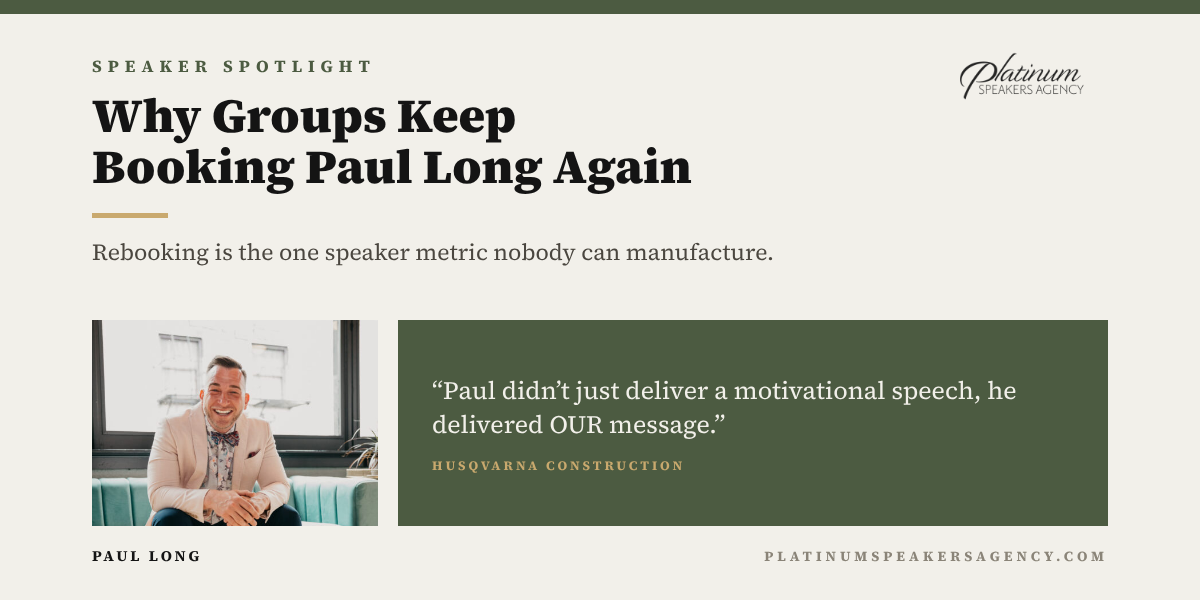
Clients hear it. “People learned a lot, including real-life, practical tips they can implement immediately,” wrote the Association of Clinical Documentation Integrity Specialists. Triumph Financial, after several engagements, pointed to “his thoughtful approach, thorough research, and clear understanding of how to drive our specific business forward.” And Husqvarna Construction put it most plainly: “Paul didn’t just deliver a motivational speech, he delivered OUR message.”
The three keynotes
Culture by Design: Transforming Workplaces One Brain Pattern Interrupt at a Time. For leaders who have been told to fix culture and handed no mechanism to do it with. Culture is not repaired in a workshop. It is built in moment-by-moment choices, and this keynote hands people the tools to make better ones.
The Unforgettable Leader: How to Create a Team No One Ever Wants to Leave. People do not leave companies, they leave managers. This one is for leaders trying to hold on to good people, and it is practical about how.
Beyond Satisfaction: Creating Customer Experiences That People Just Can’t Stop Talking About. For frontline teams and the leaders responsible for loyalty metrics. Every interaction is an opportunity for an interrupt, and the ones people remember are rarely the ones in the script.
Where Paul fits on the roster
If culture and engagement are your theme, Ben Whiting comes at it through what happens when people know they matter, and Justin Jones-Fosu comes at it through meaningful work and the conversations teams avoid having. Tami Evans is the one to call when a room needs lightening rather than lecturing, and Sara Ross when burnout and sustainable performance are the real issue underneath.
Paul is the one for groups that need re-energizing and something concrete to do on Monday.
If you are weighing options for an upcoming meeting, our guide to booking a keynote speaker walks through how to match the message to the moment. And if you would rather just talk it through, I am happy to help you work out whether Paul is the right workplace culture keynote speaker for your group, or point you toward someone who fits it better.
That second part matters more than it sounds. The goal was never to place a speaker. It is to make sure the group remembers the day, and that somebody wants him back.