

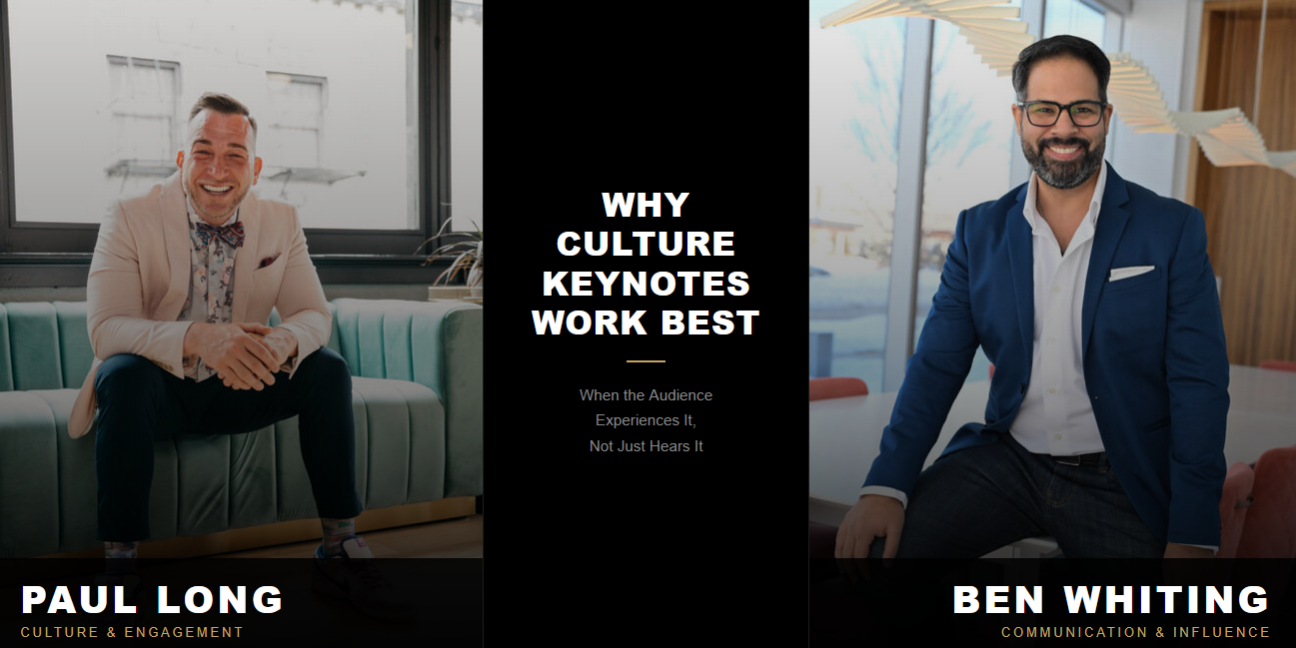
Here’s something I’ve noticed after years of matching speakers to events: the culture keynotes that actually change something share one thing in common. The audience doesn’t just hear the message. They feel it happen in real time.
There’s a big difference between a keynote that explains how connection works and one that creates a moment of genuine connection right there in the room. Between a talk that describes what it looks like when people are fully present and one that breaks the pattern of distraction mid-session. Between information about culture and an actual experience of it.
Two speakers on the Platinum roster have built their entire approach around this distinction.
The Problem with Most Culture Keynotes
Most organizations bring in a culture speaker because something isn’t working. Engagement is low. Teams feel disconnected. The customer experience is inconsistent. People are going through the motions.
So they book a speaker. The speaker talks about culture for 60 minutes. Everyone nods. A few people take notes. And then the afternoon session starts and the energy from the morning is already fading.
The issue isn’t the message. The issue is the medium.
Culture doesn’t change because people learn new information about it. Culture changes because people have a new experience — and then choose to repeat it. That’s what makes it stick. That’s what makes people walk out of an event and actually do something differently on Monday morning.
The two speakers I’m featuring this month understand that better than almost anyone I know.
Ben Whiting: Connection You Can Feel Happening
Ben Whiting is a communication and influence speaker who also happens to be a former professional mentalist. That combination sounds like a party trick. It isn’t.
Ben’s keynote, Creating a Limitless Culture, uses magic and mind reading as a live demonstration of how influence, communication, and connection actually work. Every illusion in the show is built around a real principle: why certain ideas stick and others don’t, how trust is built or broken in a single interaction, what it looks like when someone is genuinely seen and heard versus when they’re being managed.
Here’s what makes it different from a traditional keynote: the audience doesn’t just watch. They participate. They experience moments that shouldn’t be possible and then Ben explains exactly what happened and why — and how the same principles apply to every meeting, every conversation, and every customer interaction they’re going to have this week.
The result is a room full of people who don’t just understand the lesson. They remember the moment.
Ben has delivered this to audiences at SHRM, Nationwide, State Farm, Keller Williams, Element Fleet Management, CFA Society, and more. When the SHRM CEO wrote “engaging, inspirational, hilarious, magical — Ben was incredibly easy to work with,” that wasn’t a polite review. That was an accurate one.
The NADA operations leader put it this way: “Vendors who attend 20 to 30 events a year were telling me he was the very best they have ever experienced.”
After a long day of breakout sessions and presentations, Ben wakes a room back up. But more than that — he gives them something they’re still talking about three days later. The MPI team said attendees were walking around the rest of the conference saying “we need to make some magic” as shorthand for the communication principles he taught. That’s culture-building. That’s a keynote that travels.
Ben is a strong fit for associations, HR conferences, leadership summits, sales kick-offs, and any all-staff event where the organization needs people to genuinely reconnect — with each other and with the work.
Paul Long: Breaking the Loop Before It Breaks Your Culture
Paul Long starts his keynote with an observation that most leaders recognize the second they hear it: your people aren’t with you. Not fully.
They’re in their heads. Stuck on the last customer interaction. Running through tomorrow’s to-do list. Weighed down by pressure they can’t name and can’t put down. They’re going through the motions, and they’ve been doing it so long they’ve stopped noticing.
Paul calls this the loop. And his message — built on the Fundamism methodology he developed after leading teams of thousands for a Fortune 300 company — is that culture doesn’t fail because of bad strategy. It fails because nobody is interrupting the loop.
His framework is simple and immediately actionable: acknowledge the loop, interrupt the pattern, anchor the moment. Brain pattern interrupts — specific, deliberate choices that snap people back into presence and possibility — are the tools Paul gives audiences to actually do this. Not someday. The next day.
What makes Paul’s message land in serious rooms (and he plays serious rooms — healthcare systems, financial services, manufacturing leaders) is that this isn’t a talk about fun. Fun is one of the tools inside the framework, not the point. Not every brain pattern interrupt is fun. Some are just honest. Some are just present. The point is that culture is built in small, deliberate moments — and most people are letting those moments go by on autopilot.
AT&T has the numbers to prove it works: “His sessions have moved numbers. The centers he has visited are performing at sustained higher levels.” That’s not a motivational bump. That’s sustained change. And it came from a keynote.
Paul is a natural fit for leadership retreats, culture events, employee engagement conferences, customer experience summits, and any organization that knows something needs to shift but hasn’t been able to make it stick.
Why These Two Together
Ben and Paul approach culture from completely different angles, and that’s exactly why they’re worth mentioning in the same breath.
Ben works from the outside in — he creates an experience so undeniably engaging that it rewires how people think about communication and connection. Paul works from the inside out — he gets people to notice the internal patterns that are quietly undermining the culture they’re trying to build.
If you have a two-day event, they pair beautifully. If you’re planning separate conferences for different audiences, they’re each strong enough to anchor their own.
And if you’re looking for a keynote that makes culture feel real — not aspirational, not theoretical, but something the audience can actually reach out and touch — either one will deliver that.
Let’s Talk About Your Event
June is historically the biggest inquiry month of the year for our agency, and both Ben and Paul are booking fast through fall. If you’re finalizing your fall event lineup or starting to plan for 2027, now is a good time to reach out.
I’d love to hear about your audience, your goals, and what you’re hoping your people walk away with. From there I can help you figure out which of these two (or someone else on our roster entirely) is the right fit.